WELCOME TO MY BLOG.

I've always had an interest in gardens and in the natural world. I soon realized that these were more than just flowers to me, but people, places, pictures, history, thoughts...
Starting from a detail seen during one of my visits, unexpected worlds come out, sometimes turned to the past, others to the future.

Travel in a Garden invites you to discover them.

Tuesday, October 9, 2012

Autumnal reflections on a boat.

I wish I could turn back time and start again from September 1st. 
I would have stayed longer in Paris with my nieces.
I would have escaped for a long-long weekend in New York to visit the promising exhibition “Monet’s Garden” at the New York Botanical Garden.
I would not have bought a pair of expensive moccasins of the most beautiful suede but of an impossible yellow. 
I would have finished to read "Tolstoy, A Russian Life" by Rosamund Barlett.
I would have written tons of new POSTS for my blog AND tons of excellent ARTICLES that English editors of gardening magazines could not have rejected.
I would have completed the presentation of my graduation thesis to be held in Venice.
I would have changed my job so that I could have joined the small group that will leave from London for two weeks between Kyoto and Tokyo in the magical autumn season.

It is five o'clock in the afternoon, Sunday October 7th, and I'm sailing on the Lake Como towards Como and the train station. I spent my day at Orticolario, the flower show held in autumn at the elegant Villa Erba, in Cernobbio. The sun is still shining on the lake, and a long queue of people is waiting to be boarded at the pier, to reach the fourth edition of this event. 

The day has quickly passed, and, just to mention flowers, I noticed there were few hydrangeas and camelia sasanqua but a very good choice of asters, with beautiful combinations of violet-mauve-pink-white flowers, different heights and simple or double corollas. There were dianthus, gaura, anemone japonica and cheap violets for winter flower-beds. Roses and orchids were the stars of the show, but not my first interest. I preferred some small, specialized productions, with informed and passionate sellers and good plants, such as ferns and heuchera. Apples, pears and grapes, on display on tables, created more interest than usual for the old varieties of fruit trees. Peonies and iris rested in big boxes where beautiful pictures tempted shy buyers. 

I discovered the “cassetta di piante” (box of plants). This is a practical and elegant planter, to be anchored outside the window, where a young French company, based in Paris, Le vert à soi, creates a true small landscape, transforming austere facades in hanging gardens.

Young students from a Dutch school of floral decorations held an interesting demonstration with seasonal flowers. I missed that of the Italian school because I left to listened to two famous Italian writers, talking about their last books and about their love for nature and gardens.

Along a path, I was surprised by two big hearts pierced by an arrow. After a quick inspection, it resulted the most sober topiary of the stand. Alexander Pope would have been inspired with a few new lines to his "Catalogue of Greens," the well-known satire against topiary dated 1713, something like: 
   
     Two hearts in Privet; one very large, full of hope and love, and one smaller, crushed by 
     an arrow that has lost direction and move.

I stopped thinking about my list of impossible desires to write true rhymes in Pope's style.


Links:
Orticolario, Villa Erba Como, Italy (to be ready for next year)
www.orticolario.it/ 
Le vert à soit, Paris, France.
http://levertasoi.fr/index2.php?rub=20

Friday, August 3, 2012

My Grandmother's Magnolia.

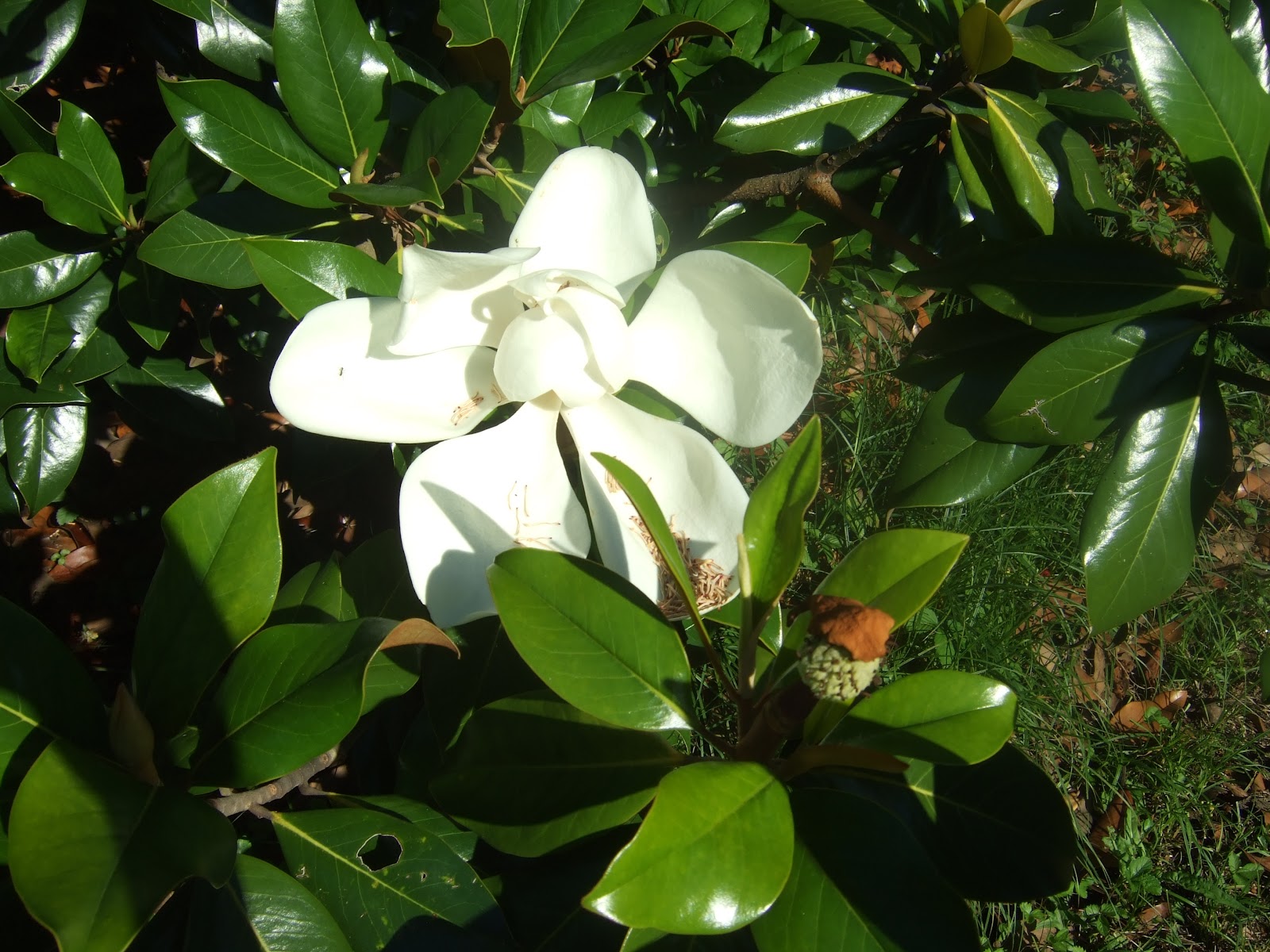
The pure-white perfumed petals of Magnolia grandiflora are fading in crunchy biscuits in the heat of these summer days.

Magnolias remind me of my grandmother and of the imposing specimen that grew in her garden. From the entrance gate, the magnolia filled the view at the end of a short gravelled slope that, flanking the left side of the house, led to a courtyard. Flowers were cultivated on both sides of the slope. On the left, parallel to a thick laurel hedge that hid the boundary wall, different small shrubs sank in the soft turf, while, on the right, against the house, a fragrant lippia citriodora, roses, wallflowers and daisies thrived in three ordered terraced flowerbeds edged with jasmine nudiflorum. Here, in early spring, my grandmother sowed lettuce, and, later in season, she stuffed all empty spaces among flowers with vigorous tomatoes, basil, parsley and spinaches. Practical needs never suffocated her pleasure for simple flowers, and, along the scalloped kerbs, ribbons of yellow and orange marigolds rejoiced the expanse of grey-white gravel where weeds dared not appear.

A rose climbed up the wall of the house. This was a serious two-storey building that her husband, my grandfather, had built indulging in garrets, stairs and ample halls. From the terrace at the second floor, where my uncle lived with his family, the top of the magnolia was deceptively close, as the annoying pigeons that rose in short flights from the neighbour’s house, or the mountains in the distance. Behind the pyramidal shape of the tree and its lustrous evergreen leaves, the garden was a spontaneous meadow, a rectangle with fruit trees and two vegetable gardens separately cultivated by my aunt and my grandmother.

Under the magnolia, in balance between the gravel and the grass, there was a low bench made of stone and no flowers. These would have hindered the wide range of chairs, stools and deck-chairs that, above all in summer, were scattered under the generous shade of the tree. Chairs were dragged back and forth: they were gathered in the deepest shade when the rays shone relentlessly devouring shady contours, or spread under the lower external branches when a sudden breath of wind or frothy clouds cooled the air.
Soon after lunch, my grandmother sat under the magnolia with her book of prayers. The rosary beads flowed fast in her long hands without rings while she was absorbed in the holy words, her eyes closed. Then, she put away her prayers, put on her glasses and began to knit or sew pieces of clothing for her grandchildren. Sometimes, the basket at her feet was full of colourful balls of wool of different texture, the old sweaters she reused for large blankets that dropped from her crochet strip after strip. Old dresses and coats became, instead, soft slippers. She designed cardboard silhouettes around our feet, and, then, going up and down the external stair of the house, from the magnolia to a room with coloured window-panes at the first floor, she sewed with her sewing-machine the different fabrics, layer after layer, until the sole got the desired thickness. She finished the upper with elegant touches so that no pair was similar to another.

Late in the afternoon, she lingered under the magnolia waiting for my uncle who, back from work, used to stop there to talk about the news she had read in the newspaper. At sunset, she worked in her garden. She weeded and watered, tied the tomatoes, fought against potato-beetles and hungry butterflies, piling up the scraps in a compost heap where pumpkins flourished. There were tomatoes, potatoes, carrots, spinaches, salads, zucchini, onions, leeks, and cutting flowers. Dahlias, lilies, aster or gladiolus were intended for the cemetery, where she went every Sunday morning, her arms full of fresh flowers wrapped in old pages of newspaper. In the afternoon, she welcomed old relatives and friends offering tea and attention under the glossy leaves of the magnolia.