WELCOME TO MY BLOG.

I've always had an interest in gardens and in the natural world. I soon realized that these were more than just flowers to me, but people, places, pictures, history, thoughts...
Starting from a detail seen during one of my visits, unexpected worlds come out, sometimes turned to the past, others to the future.

Travel in a Garden invites you to discover them.
Showing posts with label SEASONS. Show all posts

Wednesday, February 26, 2020

Words in pictures: Primavera

Primavera, Gherardi Cristofano called Doceno (1508/ 1556)
Palazzo Vecchio, Florence
Ceiling painting

Tuesday, October 29, 2019

Words in pictures: Autumn Landscapes by Milton Avery (1885-1965)

Fall in Vermont, 1935. Oil on canvas, 32 × 40 inches. Collection of The Milton and Sally Avery Arts Foundation. © 2016 The Milton Avery Trust / Artists Rights Society (ARS), New York.


Autumn Landscape, circa 1939. Oil on canvas. 61x91,4cm. Private collection.

Autumn in the Rockies, 1948.

Hint of Autumn, 1954. Oil on canvas. 136.5 x 86.4 cm. Private collection.

Sunday, April 21, 2019

Birds Nest, Apple Blossom and Primroses.


[...] the only master I longed for would not teach, i.e. old William Hunt, whose work will live for ever, as it is absolutely true to nature. We used to see a good deal of him at Hastings, where he generally passed his winters, living in a small house almost on the beach under the East Cliff, where he made most delicious little pencil-sketches of boats and fishermen. I can see him now, looking up with his funny great smiling head, and long gray hair, above the poor dwarfish figure, and his pretty wife, with her dainty little openwork stockings and shoes, trying to drag him off for a proper walk on the parade with her daughter and niece, where he looked entirely out of character. I remember "That Boy," too, whom Hunt taught to be anything he chose as model, blowing the hot pudding, fighting the wasp, or taking the physic; the apple-blossoms and birds'-nests, with their exquisite mosses and ivy-leaved backgrounds, were found in the hedges and gardens about Hastings.


From Recollections of a happy life, being the autobiography of Marianne North, by North, Marianne, (1830-1890), 1892.

Birds Nest, Apple Blossom and Primroses, William Henry Hunt (1790-1864), Watercolour, bodycolour and gum, on paper 
© Birmingham Museums and Art Gallery


Saturday, April 20, 2019

Words in pictures: apple blossoms

Victoria Fantin-Latour, neƩ Dubourg (1840-1926)

Gustave Courbet (1819-1877)

Henri Fantin-Latour (1836-1904) 
Fleurs de pommier, 1873. Oil on canvas


Martin J. Heade (1819-1904)
Hummingbird and Apple Blossoms, 1875. Oil on canvas 

Kreyder Alexis Joseph, 1839-1912

Natalia Goncharova (1881-1962)  


Saturday, March 23, 2019

Spring

Ffurs fare you well, the winter is quite gone
and beauty’s quarter now is coming on
When nature striveth most to shew her pride
our beauty's being the chief we must not hid


Ver - Spring, Wenceslaus Hollar (1607–1677), 1641. Etching. 
Series/Portfolio:Three-quarter-length seasons

Friday, February 1, 2019

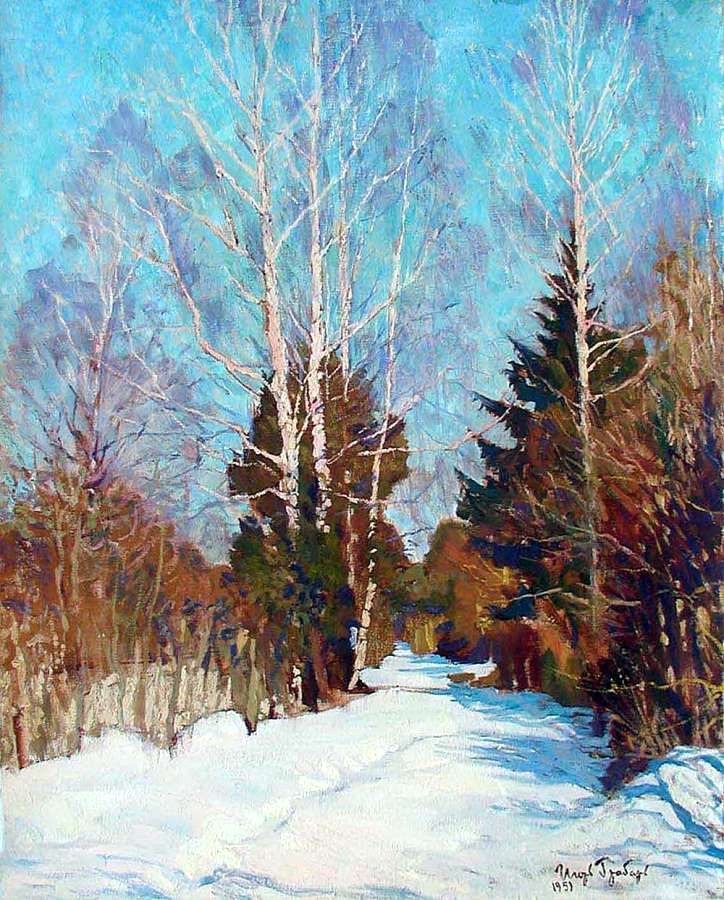
Words in pictures: snow снег


Igor Grabar (1874-1960) Š˜Š³Š¾Ń€ŃŒ Š“Ń€Š°Š±Š°Ń€ŃŒ

A Winter's Day. 1941. Oil on canvas
Royal Collection Trust / © Her Majesty Queen Elizabeth II 2019

A Winter Landscape. Зимний пейзаж. 1954. Oil on canvas

Winter Landscape. Зимний пейзаж. 1951. Oil on canvas

Winter morning зимнее ŃƒŃ‚Ń€Š¾. 1907. Oil on canvas

February azure. Š¤ŠµŠ²Ń€Š°Š»ŃŒŃŠŗŠ°Ń Š»Š°Š·ŃƒŃ€ŃŒ. 1904. Oil on canvas

Sunday, July 29, 2018

Summer flowers by Vanessa Bell.

"The garden ..is incredibly beautiful...full of reds of all kinds, scabious & hollyhocks & mallows & every kind of red from red to lead to black. Pokers are coming out. It's all in very good order & we have masses of plums and apples. I have of course begun by painting some flowers, it seems the inevitable way to begin here." Vanessa to Roger Fry, 6 August 1930 


Photos:
TravelinaGarden, Charleston, August 2016

Paintings by Vanessa Bell (1879 - 1961)


Dahlias and Canterbury Bells,

Flowers in a Blue Vase, 1951

Still Life with Flowers,

Summer Flowers in a Glass Vase, ca. 1945

Hydrangeas, 1946

Flowers in a Black Pot, c. 1946


Further reading:
Charleston a Bloomsbury house & garden
Quentin Bell & Virginia Nicholson
Frances Lincoln Limited, 1997 London

(quotation p. 134)


Link:
Charleston, Firle, Lewes
East Sussex 

Friday, January 5, 2018

Winter gardens by J.W.L.

The Ladies' Companion at Home and Abroad dated Saturday, January 26, 1850 included an article, dedicated to  Winter Gardens signed by J.W.L., page 61. 

Between December 1849 and June 1850, Jane Webb Loudon (1807-58) was the editor of this weekly magazine published by Bradbury and Evans. "Assisted by the most eminent writers and artists", she wrote about fashion and arts, literature and poetry, geology and geography, travels, books, concerts and exhibitions. She answered her readers' letters, offered games for children, scientific cooking, schemes for embroideries, crochet works and hair bracelets, gardening tips and botany lessons.

When the garden in winter is "gloomy", she writes, winter gardens, or conservatories, allow people to walk among exotic trees, "and thus enjoy the beauty of good scenery when the ground beyond the glass is covered with snow."  

A small winter garden could be an adjunct to a drawing-room or a library, or a passage between different parts of a house, see Fig.1, and is perfectly affordable. Decorated with statues, it is perfect for evergreens such as: "Camellias and Orange trees, ... creeping-plants such as Coboea scandens, Tacsonia, and some of the hardier kind of Passion flower...", plants that do not require artificial heating.

At page 96, she adds a further article about the real winter garden, that is "a garden of about an acre in extent, laid out with walks beds, fountains, and other usual appendages of pleasure-grounds and only different from an ordinary garden in having glass between it and open air." Fig.2 with real trees such as "Musa Cavendishii, and the Palm by Chamaerops humilis. Against the pillars may be trained Habrothamnus fasciculatus..."
She mentions addresses of suppliers for conservatories and "ornamental tallies." A brief history of winter gardens is proposed together with beautiful winter gardens in London and abroad from Russia to Berlin, but "none of these,... are equal to the one lately formed in the Champs-ƉlysĆ©es, in Paris.


Quotations from:
The Ladies' Companion At Home and Abroad
N.V London: Saturday, January 26, 1850
Fig. 1 p. 61
Fig. 2 p. 96
British Library

Sunday, November 26, 2017

Words in pictures: Autumn by Mikhail Vasilievich Nesterov.

Autumn Landscape, ŠžŃŠµŠ½Š½ŠøŠ¹ пейзаж , 1906
Autumn birches, ŠžŃŠµŠ½Š½ŠøŠµ березы
 Autumn Landscape, ŠžŃŠµŠ½Š½ŠøŠ¹ пейзаж, 1934
In the Autumn Forest, Š’ ŠžŃŠµŠ½Š½ŠµŠ¼ лесу
Autumn in the Village, ŠžŃŠµŠ½ŃŒ в Геревне, 1942

Paintings by Mikhail Vasilievich Nesterov (1862 – 1942)

Autumn Landscape, ŠžŃŠµŠ½Š½ŠøŠ¹ пейзаж , 1906
Autumn Landscape, ŠžŃŠµŠ½Š½ŠøŠ¹ пейзаж, 1934

Autumn birches, ŠžŃŠµŠ½Š½ŠøŠµ березы

In the Autumn Forest, Š’ ŠžŃŠµŠ½Š½ŠµŠ¼ лесу

Autumn in the Village, ŠžŃŠµŠ½ŃŒ в Геревне, 1942

Tuesday, February 14, 2017

"When does spring commence?"


Mr. E.A. Bowles (1865-1954), horticulturalist, plantsman and garden writer, asks: "When does spring commence?" in the first chapter of his book My garden in spring, published in 1914.

He explores the question from different points of view, ignoring the obvious answer, that is "the 21st of March". 
He takes into account: "the astronomical point of view", Hesiod's Work and Day, Pliny's Natural History, and the scientific certainties of the meteorologists based upon the "increase of the average daily temperature". 

Not satisfied with the answers, he turns to the garden and solemnly determines that the "starting to grow" marks the beginning of the new season. It is a universal event announced by "a melting of the covering of snow ... with the high alpines, or the commencement of the rains in the African veld."    


And to find the flower that "recalls a feeling of Spring", he follows the smell of a bloom with "a promise of honey in it strong enough to wake any bee..." and "soft lilac colouring and crystalline texture and frail substance..." 

He concludes,

"... I shall elect Iris unguicularis as the first flower of Spring, and arrange further chapters more on the flowers themselves than on the dates of their flowering."

and I continue my reading... happy...


Photos:
Travelinagarden

Further reading:
My garden in spring, E.A. Bowles,
New York: Dodge Pub. Co., [1914]
http://dx.doi.org/10.5962/bhl.title.19768


Saturday, December 24, 2016

The Art of Chabana: November and December


Material: Euonymus alatus compactus
Vase: Swedish ceramic vase


Winter is here. It becomes dark earlier every day but it is still not so ruthlessly cold. 
Wandering in the silent garden looking for flowers for the tea ceremony is a pleasant and relaxing occupation even if there are no flowers, too late for camelia and too early for narcissus, snowdrops and cyclamen. The group of Helleborus niger, whose snowy flowers are the stars of all florists shops this year, is just a mass of glossy green leaves, but elsewhere in the garden there are promising buds, such as a young shrub of Edgeworthia papyfera or the imposing Chimonanthus praecox. 
Tree and shrub branches are the best choice for the chabana in winter. In his book "The Art of Chabana", Henry Mittwer suggests those of Euonymous sieboldianus, Corylus Thunbergii, Pahrabenzoin praecox and Alnus japonica, recommending to choose branches with buds. 

For November, I chose three branches of Euonymus alatus compactus, whose unusual winged branches are often forgotten after the intense autumn colours. 
The white ceramic vase, which seems a branch itself, is the same for the chabana of December with hazel and Chimonanthus praeocox branches. The branch of Chimonanthus was in bud two weeks ago, its scent is probably considered too strong for chabana, but now it's in full bloom and perfumes the kitchen of winter.


Material: Corylus avelana, Chimonanthus praecox
Vase: Swedish ceramic vase


Photos:
TravelinaGarden, November and December 2016


Further reading:
Henry Mittwer, The Art of Chabana: Flowers for the Tea Ceremony, Charles E. Tuttle Company Inc., Tokyo, 1974.


Links to the previous posts:

Saturday, November 5, 2016

The Art of Chabana: October.


Material: Ceratostigma plumbaginoides, Camellia sasanqua, Acer palmatum.
Vase: white ceramic vase.


Rain has come at last and in a few days all the fiery autumn colours will be  scattered in the lawn or in indistinct wet piles at the side of the road. I'm using the small dried branches of the hydrangeas that I pruned in early spring to light the fireplace, and large logs to keep it on.

In his book 'The Art of Chabana: Flowers for the Tea Ceremony', Mittwer suggests 'tree and shrub branches' for the Chabana in the colder months. He lists the winged spindle, for example, to be used just when 'the leaves have started to turn crimson'. He adds useful information: 'to select a branch with a nice line', to avoid baskets, and to use a white camellia or wild flowers for nejime, that is for the base of the flower arrangement.  

I walked in the garden and ignoring the Schiapparelli pink of the Euonymus alatus, I chose a combination of colours and the last flowers of the season. 


Photos:
TravelinaGarden, October 2016

Further reading:
Henry Mittwer, The Art of Chabana: Flowers for the Tea Ceremony, Charles E. Tuttle Company Inc., Tokyo, 1974.


Links to the previous posts:

Sunday, October 9, 2016

Giovane con canestra di frutta, 'Boy with a Basket of Fruit', Caravaggio 1593-94/ Ravo 2016.

Michelangelo Merisi (1571-1610), the Italian painter known as Caravaggio, painted 'Boy with a Basket of Fruit' towards the end of the sixteenth-century, probably in Rome. The portrait of the melancholic boy holding a basket is exquisitely expressive and detailed. Autumn fruits, in particular, are tempting with an abundance of fresh grape, peaches and figs. Medlars, apples, small pears and a pomegranate half hidden by the leaves add to the richness of the season. 

Today, this beautiful oil on canvas is on display at the museum at the Galleria Borghese in Rome AND on the external wall of a private house in Angera, a town on the shores of Lake Maggiore. 
In September, Andrea Ravo Mattoni transformed the painting in a huge mural, working  hard with spray cans for one week. 
With artistic studies at the Academy of Brera in Milan, Ravo has shift his spray cans from trains to walls, interpreting with his murals the works of the most famous Italian painters. He has a special interest in Caravaggio, and a special talent for his paintings. 
 
Photos:TravelinaGarden, Angera, October 2016