WELCOME TO MY BLOG.

I've always had an interest in gardens and in the natural world. I soon realized that these were more than just flowers to me, but people, places, pictures, history, thoughts...
Starting from a detail seen during one of my visits, unexpected worlds come out, sometimes turned to the past, others to the future.

Travel in a Garden invites you to discover them.

Monday, April 14, 2014

The Garden of Bloom, Markus Benesch blooms at Vivaio Riva, Milan.

'Morning Glory' installation
There is always something new at the Vivaio Riva in Milan. It's not just the flowers that change along the seasons, but the different voices that echo in this magic garden nested in the center of Milan. The refined flowers of one of the oldest nursery in town, in fact, frame exhibitions, concerts, talks and birthday parties, orchid enthusiasts, school children and the unusual sound of chirping birds. 
'Bricky seeds'
During the International Design Week, for the FuoriSalone, Vivaio Riva hosted the new furniture and wallpaper collection created by the German industrial and interior designer Markus Benesch: 'Brickcolletion'. The colored pattern, inspired by the children's building blocks, was repeated on tables, furniture and home accessories. The sequence of lively colors was irresistible, the smooth surfaces inviting.

The regular squares captured the joy of the spring blooms and returned it through colors, forms and light. A silent but powerful language that, for a while, made me forget the flowers.


'Bricky Falls' installation

Photos:
TravelinaGarden, Milan, April 2014.


Further links:
Vivaio Riva
Via Arena 7, 20123 Milano.

Markus Benech Creates
Mariannenplatz 1 München
Via Tiepolo 58 Milano 
http://www.markusbeneschcreates.com/info.html

FuoriSalone
Milano Design Week, April 8-13 2014

http://fuorisalone.it/2014

Saturday, March 22, 2014

The cloister of the frogs, Santa Maria delle Grazie, Milan.


There were farms, gardens and cultivated fields around the Church and Dominican Convent of Santa Maria  delle Grazie (Holy Mary of Grace) when, around 1490, Ludovico Sforza (1452-1508), the Duke of Milan, decided to transform the beloved church into the mausoleum of the Sforza family.

The architect Donato Bramante (1444-1514) was involved in the works for the tribune and  its imposing dome, while Leonardo da Vinci (1452-1519) painted The Last Supper, the famous tempera mural, in the refectory of the Convent.

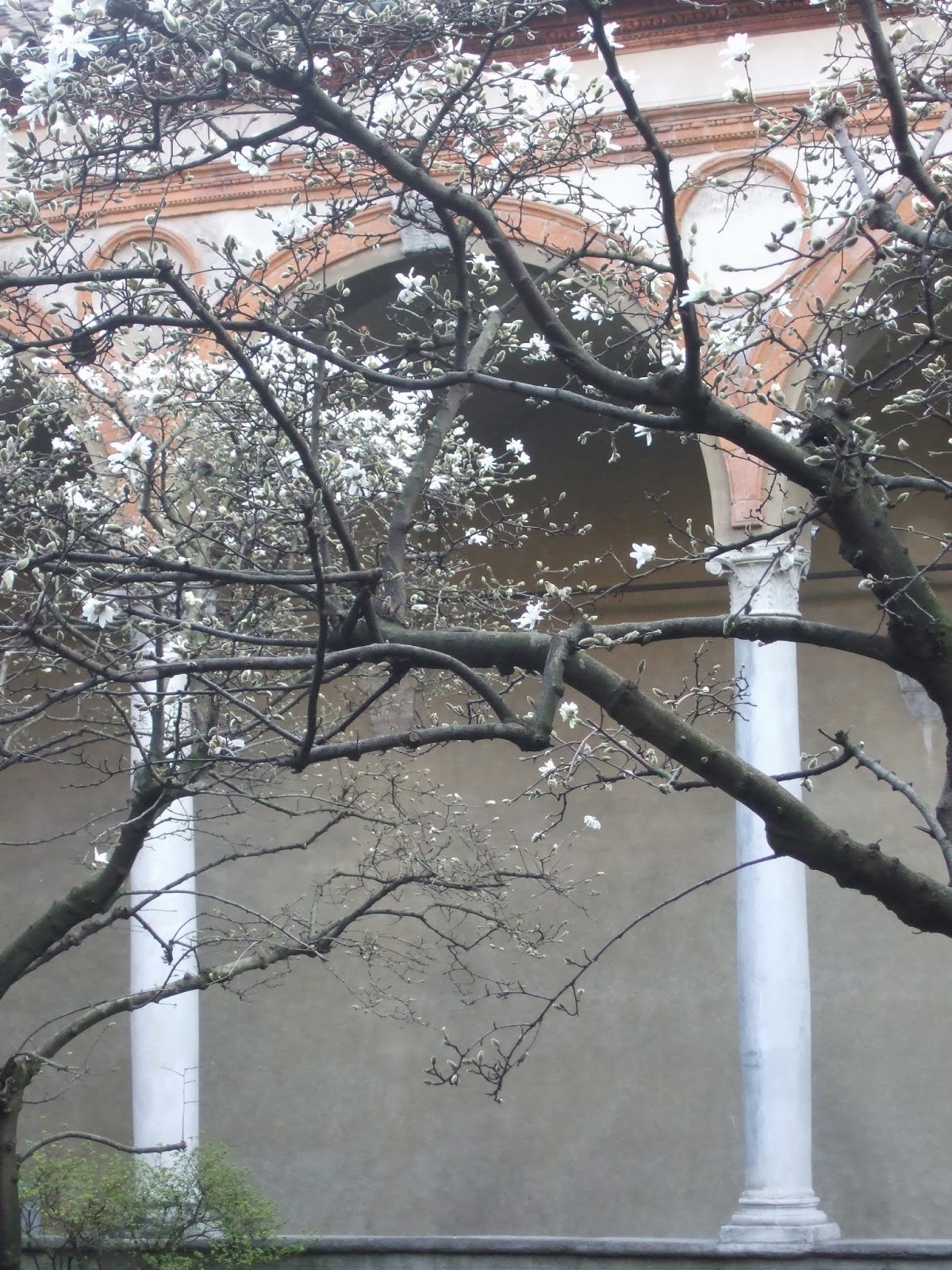
To connect the tribune to the sacresty, Bramante created a chiostrino (small cloister). Simple and elegant, the quadrangular cloister has five arches on each side supported by slender columns. The central garden is crossed by perpendicular cobbled paths with a round basin in the centre. Spring magnolias are planted in the four quadrants.

The cloister is also called the Chiostro delle rane (The cloister of the frogs) because of the four bronze batrachians that, squatting on the edges, spout happily fresh water. I have found no information about their introduction in this peaceful garden, but I like to think that they are a reminder of the rice fields and the flourishing kitchen gardens that punctuated the region a long time ago.
In 1498, a grateful Ludovico Sforza donated to Leonardo da Vinci the vineyard next to Santa Maria delle Grazie to remunerate for his services.


Photos:
TravelinaGarden, Milan, March 2014.


Further reading:
Francesco Malaguzzi Valeri, La Corte di Ludovico il Moro, Bramante e Leonardo da Vinci, Ulrico Hoepli, Milano 1915.