
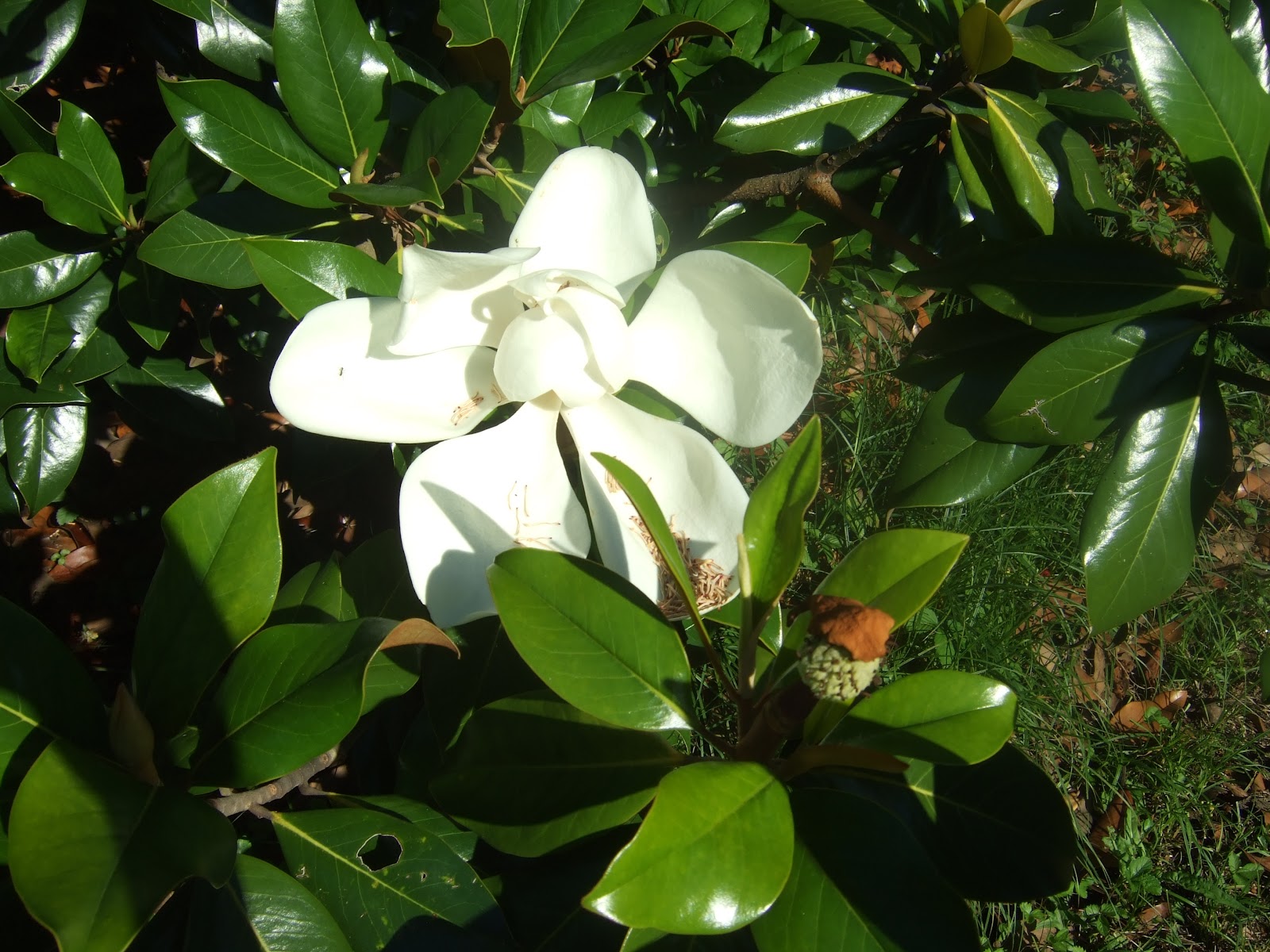
The pure-white perfumed petals of Magnolia grandiflora are fading in crunchy biscuits in the heat of these summer days.
Magnolias remind me of my grandmother and of the imposing specimen that grew in her garden. From the entrance gate, the magnolia filled the view at the end of a short gravelled slope that, flanking the left side of the house, led to a courtyard. Flowers were cultivated on both sides of the slope. On the left, parallel to a thick laurel hedge that hid the boundary wall, different small shrubs sank in the soft turf, while, on the right, against the house, a fragrant lippia citriodora, roses, wallflowers and daisies thrived in three ordered terraced flowerbeds edged with jasmine nudiflorum. Here, in early spring, my grandmother sowed lettuce, and, later in season, she stuffed all empty spaces among flowers with vigorous tomatoes, basil, parsley and spinaches. Practical needs never suffocated her pleasure for simple flowers, and, along the scalloped kerbs, ribbons of yellow and orange marigolds rejoiced the expanse of grey-white gravel where weeds dared not appear.
A rose climbed up the wall of the house. This was a serious two-storey building that her husband, my grandfather, had built indulging in garrets, stairs and ample halls. From the terrace at the second floor, where my uncle lived with his family, the top of the magnolia was deceptively close, as the annoying pigeons that rose in short flights from the neighbour’s house, or the mountains in the distance. Behind the pyramidal shape of the tree and its lustrous evergreen leaves, the garden was a spontaneous meadow, a rectangle with fruit trees and two vegetable gardens separately cultivated by my aunt and my grandmother.
Under the magnolia, in balance between the gravel and the grass, there was a low bench made of stone and no flowers. These would have hindered the wide range of chairs, stools and deck-chairs that, above all in summer, were scattered under the generous shade of the tree. Chairs were dragged back and forth: they were gathered in the deepest shade when the rays shone relentlessly devouring shady contours, or spread under the lower external branches when a sudden breath of wind or frothy clouds cooled the air.
Under the magnolia, in balance between the gravel and the grass, there was a low bench made of stone and no flowers. These would have hindered the wide range of chairs, stools and deck-chairs that, above all in summer, were scattered under the generous shade of the tree. Chairs were dragged back and forth: they were gathered in the deepest shade when the rays shone relentlessly devouring shady contours, or spread under the lower external branches when a sudden breath of wind or frothy clouds cooled the air.

Soon after lunch, my grandmother sat under the magnolia with her book of prayers. The rosary beads flowed fast in her long hands without rings while she was absorbed in the holy words, her eyes closed. Then, she put away her prayers, put on her glasses and began to knit or sew pieces of clothing for her grandchildren. Sometimes, the basket at her feet was full of colourful balls of wool of different texture, the old sweaters she reused for large blankets that dropped from her crochet strip after strip. Old dresses and coats became, instead, soft slippers. She designed cardboard silhouettes around our feet, and, then, going up and down the external stair of the house, from the magnolia to a room with coloured window-panes at the first floor, she sewed with her sewing-machine the different fabrics, layer after layer, until the sole got the desired thickness. She finished the upper with elegant touches so that no pair was similar to another.
Late in the afternoon, she lingered under the magnolia waiting for my uncle who, back from work, used to stop there to talk about the news she had read in the newspaper. At sunset, she worked in her garden. She weeded and watered, tied the tomatoes, fought against potato-beetles and hungry butterflies, piling up the scraps in a compost heap where pumpkins flourished. There were tomatoes, potatoes, carrots, spinaches, salads, zucchini, onions, leeks, and cutting flowers. Dahlias, lilies, aster or gladiolus were intended for the cemetery, where she went every Sunday morning, her arms full of fresh flowers wrapped in old pages of newspaper. In the afternoon, she welcomed old relatives and friends offering tea and attention under the glossy leaves of the magnolia.


